
The Fixer
The Forty Servants in Theory & Practice

Hello, good people of the internet, and welcome back to The Forty Servants in Theory and Practice, a series where I have a deeper look into the philosophy, use, and evolution of the Magick and Divination system: The Forty Servants.
Each entry will focus on one Servant at a time, offering background insight, design history, divination reflections, shadow aspects, magical applications, and how my personal understanding of each has shifted or deepened over the years.
If you know nothing about The Forty Servants, then have a look at this link HERE. You can start using The Forty Servants straight away, as there are totally free resources available at that link that give you access to everything the system has to offer. You can start working with the Servant today without having to open your wallet or sign up, or anything other than read some web pages.
If you would like to support this series and the rest of the stuff I do, then please consider a paid Patreon Membership, buying me a coffee, or sending a PayPal donation! All amounts, even very small ones, all really, really help to keep the engine running here.
So, let’s go…
THE FIXER
“The Fixer shows us that any problem can be solved if we are willing to do what is needed. He encourages us to do what must be done to get the desired outcome we seek—no matter the cost.”
THE ARTWORK
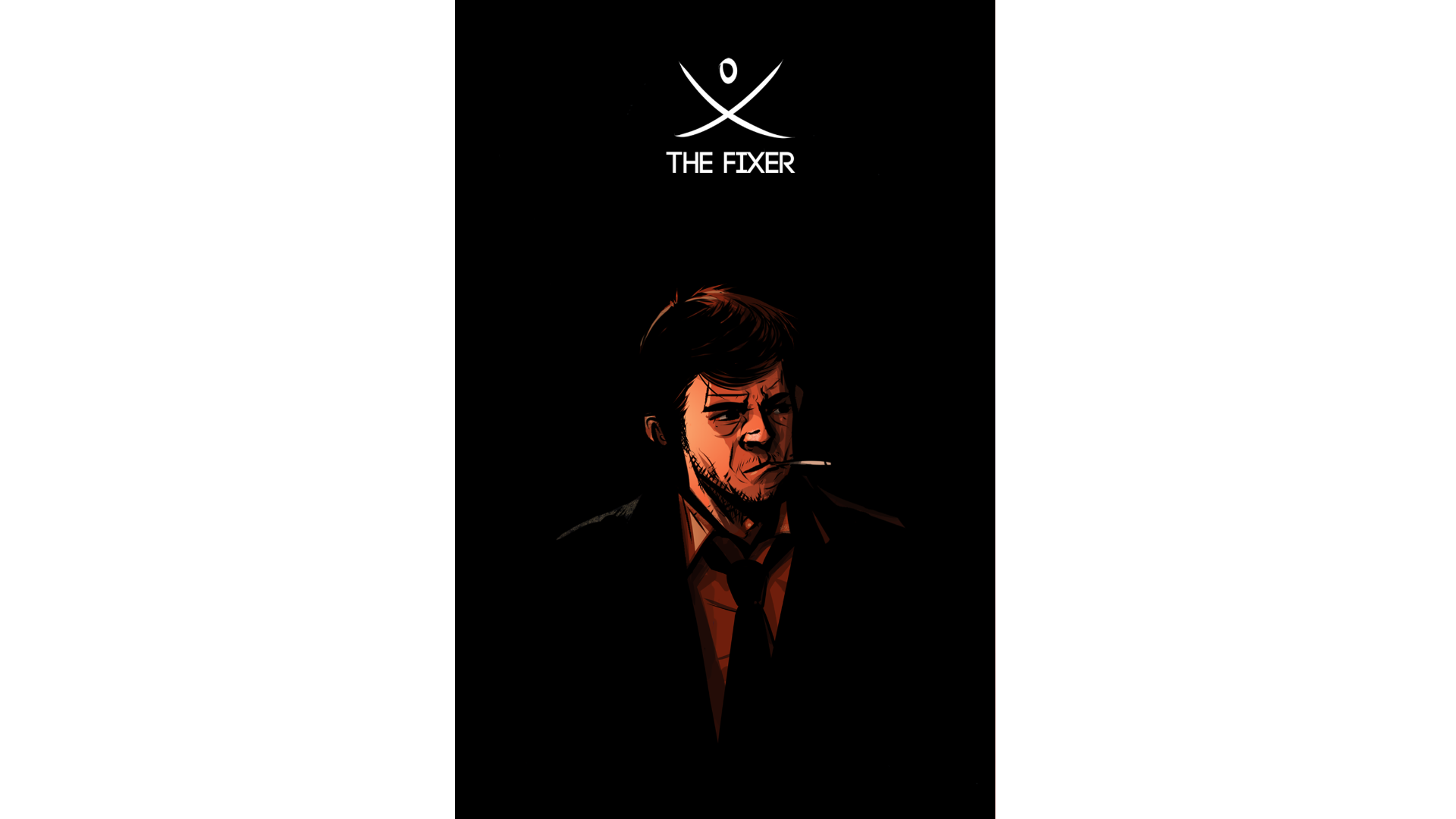
Like a number of other Servants, the artwork for The Fixer comes from the first, and ultimately unpublished, version of my comic The Great Work. This version was five pages long and used a very different art style than I ended up using in the published version of the comic. This original opening storyline took a rather cynical, conspiratorial dive into how society reached its current state, which ultimately clashed with the more personal narrative I was trying to build with the comic in general, and so I started again with a new approach. I was glad I was able to come back to this art and reuse it for some of the Servants, as I really liked a lot of it.
I did make some changes to the art for The Fixer, though. In the original, he is walking down a street surrounded by people, and while I liked this, I felt it was a bit too busy for use in the deck art. Instead, I put him in plain dark shadows and changed the colour tone to an orangey-red. I also re-drew him a fair bit by adding a lot more detail, fixing the hair and tie, adding some stubble, and giving him a cigarette.
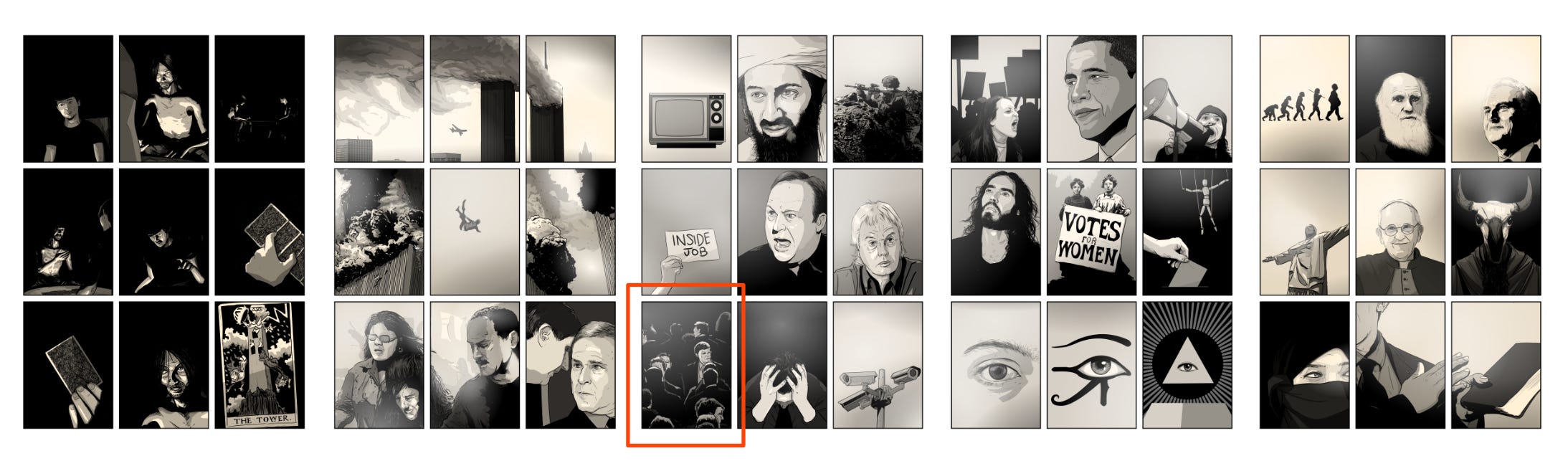
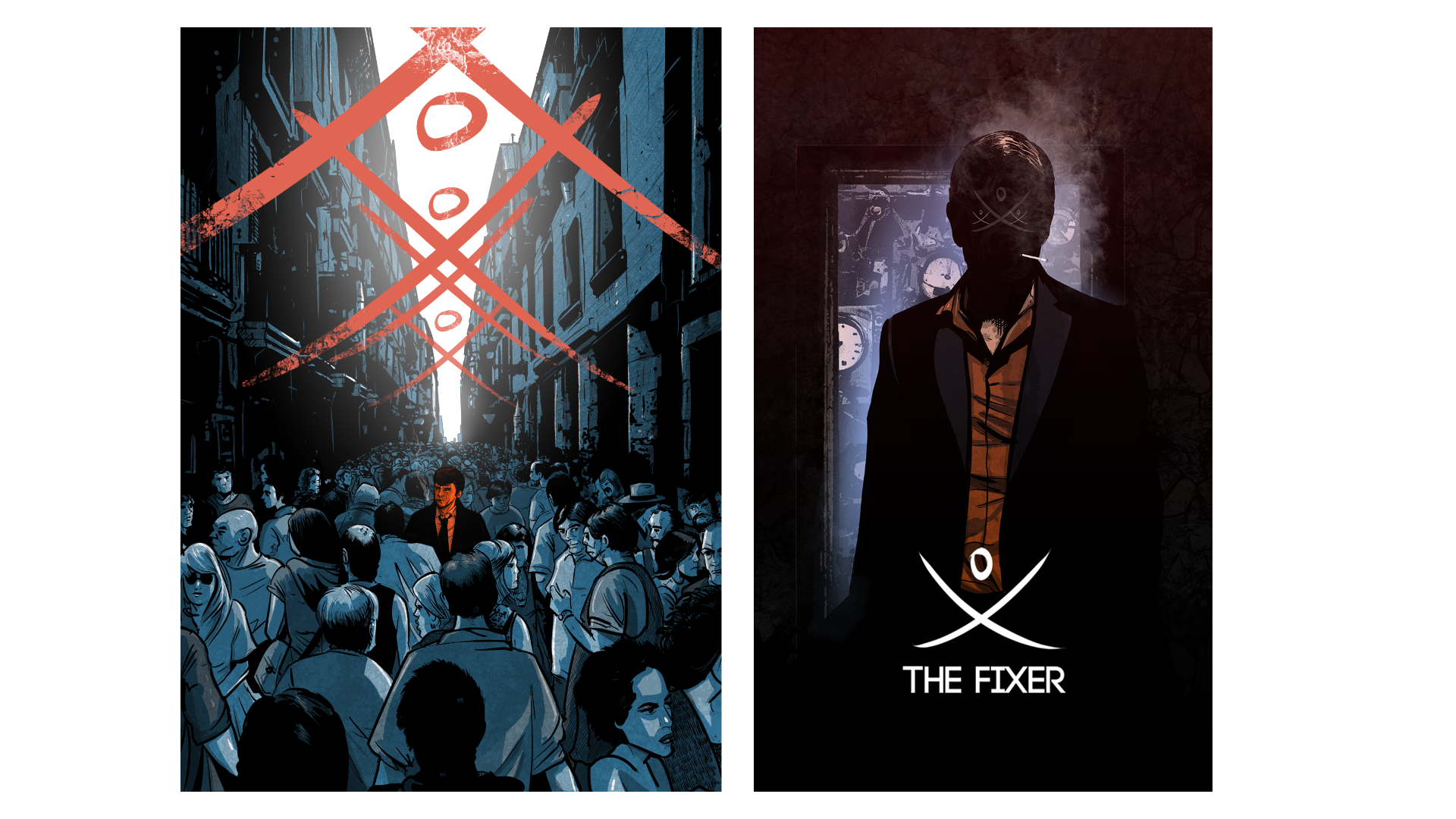
I like the drawing, and I think it gives the Fixer has good swagger and character. He is one of the few Servants that I have done more artwork of over the years—I did two more versions of him, which you can see below, one of which returns him to his original street scene.
With art for The Fixer is hard to find a balance between showing him as being a no-nonsense sort of guy who is serious business, but not turning him into some sort of bogeyman or cliché hitman. His imagery should be ominous—after all, he is the Servant of last resorts—but he isn’t a devil or demon that you bargain your soul with, which is something that people often mistake him for. I’m not sure if my pictorial representations really helped or added to the confusion on this, but they are what they are, and for me, they capture his essence perfectly.

DIVINATION
The Fixer was always the Servant that most people got confused about, as to what he represents. I found this quite exasperating over the years because no matter how simply I would try to explain it—or how often—some people just couldn’t get it, or refused to get it! I’m pretty certain that most of the confusion and misunderstanding comes from people not ever actually reading the description in the Grimoire or on the AIWW website, or my subsequent article on him. Also, I suspect that some of it may have come from miscommunications and misunderstandings in the various translations that were done. And some of it came from people looking at the image alone and coming up with their own version of who The Fixer was, and then demanding that that is what I meant in the first place, and I was now confused about him.
Simply put, when The Fixer comes up in a reading, it asks the question: Are you willing to do whatever it takes to get your desired outcome? The Servant suggests that anything can be achieved as long as you are willing to pay the price to get it.
Now, this is the part where people run straight to pacts with demons. They see “pay the price”, and immediately a contract with the devil comes to mind where they must give up their soul, firstborn child, or even pluck out their own eye in order to get what they desire.
But what The Fixer is actually pointing at is the idea that you can get whatever you desire, but you will have to accept all the costs and fallout that goes with achieving it. Are you willing to brownnose the boss to get the promotion? Are you willing to have everyone in the office look down on you for doing so? Are you willing to do sexual favours to get the job? Are you willing to fuck over your friends to get it? If it came to it, would you hire someone to beat up your rival or incapacitate them in some way that would make them unsuitable for the job and therefore no longer a threat to you?
I could go on, and these are extreme examples of what I mean by “willing to do whatever it takes”, but these sorts of things are the reason why The Fixer is to be treated as a Servant of last resort. Why? Because usually we don’t need to do anything close to that severe to get what we want, or we realise that no, I’m not willing to pay that price. Or, I don’t want to have to become that type of person to get what I want.
You could murder your husband and get the life insurance money, but is that who you want to be? And maybe the answer is yes. Maybe you’re willing to do some devious or immoral things to get what I want. But again, there are often less drastic avenues to explore and exhaust first.
And the price to be paid doesn’t always have to be something terrible or extreme; in fact, mostly it’s not. The example I used to always give was writing a book, and that if you wanted to write a book, then you actually had to sit down and write the book—that was the price you had to pay, and that is what The Fixer would represent in this case. However, Ai has kinda destroyed that example, as now you can have an LLM write a book for you. And maybe that’s the new price you have to pay.
So, when The Fixer comes up in a reading its saying that the outcome you want is possible, but are you willing to do the hard work, pay the price, or put up with the fallout? The outcome is possible, but you will have to work for it, make sacrifices to get it, do things you don’t want to do to achieve it, or do some risky or even “bad” things to get your way. Is this what you want to do?
SHADOW REVERSAL
In his shadow aspect, The Fixer points to meddling and causing more harm than good. When the energy of The Fixer is reversed or unbalanced, you may find that you are over-correcting and trying to “fix” things that aren’t actually broken. It’s the energy of not being able to accept things as they are, refusing to move on, and constantly tinkering until you ruin the situation entirely.
The shadow of The Fixer can also manifest as feeling you must pay far too high a price for something, or conversely, suffering from the paranoid delusion that you are going to be “punished” for getting what you want, even when no such price exists. Or that you must sacrifice something dear to you to get something else. It’s seeing contracts with the devil where there is none, or feeling you are making pacts with demons that don’t actually exist.
Remember, the price to be paid will ALWAYS be directly related to the desired goal. It’s not a random sacrifice of something you love as an offering to The Fixer—the price is never paid to the Fixer—the price is the cost of doing business.
MAGICK
The Fixer is the servant of last resort and should only be used when you have tried every other means. Why? Because many other Servants could be used first to try to attain your goal, and they don’t involve the same level of cost. The Fixer is the embodiment of doing “whatever it takes”, so you have to be absolutely sure that’s what you want.
The Fixer should be used when you have come to your breaking point and absolutely want the matter resolved, no matter the cost, work involved, or upheaval caused. Nothing else has worked, and you are OK with going nuclear on something. This should not be magick you use just to give something an extra power buff or bit of an ommpfh (use The Sun for that instead), no, this is for magick when nothing else will do you but to have the desired outcome.
To set The Fixer to work, explain the circumstances of the problem to him as if he were a person in the room with you and ask him to help fix it. Then, and most importantly, you must say out loud that you will accept whatever the cost is. You must state that you are willing to accept the ramifications of whatever has to be done for you to get your desired outcome.
The solution will very soon present itself, either resolved by itself, or you will know exactly what you have to do. With The Fixer, there will usually be some action you will have to take for the desired result to manifest, and of course, up until you actually take said action, you can still decide whether the price is worth it or not.
And to reiterate, when you use The Fixer, there is a Price to be Paid—but it isn’t to him; it’s never to him! It’s always directly related to the desired outcome.
You aren’t hiring him like a supernatural thug. You aren’t bargaining with him, giving him a fee, or making a weird, bloody sacrifice to him. The price to be paid is doing or allowing whatever it is that needs to be done to get what you want—and then being OK with the repercussions.
For example, if you want to drive a car, the “price you pay” is taking the driving lessons, learning the theory, and passing the test. If you want to get a job, but both you and your best friend apply for it, the cost of getting that job might be the loss of that friendship. Or, if you want to have an affair, the price you must pay is lies, secrecy, and deceit.
Like all Servants, when the job is done, you can give a public thanks, a candle offering, some incense or whatever token gesture you said you would do. And that’s it! No unusual payments.
SERVANT COMBINATIONS
Combine The Fixer With The Idea. If you are in a situation where you need to think fast and creatively to solve a complex problem. The Fixer brings determination and follow-through to the fresh inspiration provided by The Idea.
A great combination for turning a disaster into a goldmine is pairing The Fixer with The Fortunate. The Fixer helps to repair the damage, and The Fortunate helps to ensure you are left in a better position than before the crisis.
Go for the combination of The Fixer and The Sun when something absolutely needs to be solved, no matter what it takes, and you need it dragged completely into the light of success. Go easy with this one.
Using The Mother together with The Fixer helps situations where you want to fix a problem but prefer everyone to walk away happy (or at least less unhappy). Again, The Mother can only do so much, so don’t expect to come away with completely clean hands.
And that’s it for this time, I hope you got something good from it. If you’d like to chat about it, you can leave a comment below, or come find me on Bluesky, though I’m not terribly active over there.
If you would like to support this series and the rest of the stuff I do, then please consider a paid Patreon Membership, buying me a coffee, or sending a PayPal donation! All amounts, even very small ones, all really, really help to keep the engine running here.
So, until next time,
MAY YOUR BEST DAYS BE AHEAD!
Tommie
THE FORTY SERVANTS IN THEORY & PRACTICE SERIES:
THE WITCH - THE GATE KEEPER - THE MOTHER
THE FATHER - THE PROTECTOR - THE SAINT
THE CONDUCTOR - THE PROTESTER - THE IDEA
THE BALANCER - THE MOON - THE LEVITATOR
THE THINKER - THE EXPLORER - THE MASTER
THE DEAD - THE SUN - THE PLANET
THE DEPLETED - THE HEALER - THE EYE
THE CARNAL - THE FORTUNATE - THE MONK
LECTURE VIDEOS:
001 — Introduction
002 — Beg, Borrow, Be.
003 — Art History
004 — The Book Of Pacts
005 — Pathworking Astral Addresses
006 — The 9 Card Spread