

The Contemplator
The Forty Servants in Theory & Practice

Hello, good people of the internet, and welcome back to The Forty Servants in Theory and Practice, a series where I have a deeper look into the philosophy, use, and evolution of the Magick and Divination system: The Forty Servants.
Each entry will focus on one Servant at a time, offering background insight, design history, divination reflections, shadow aspects, magical applications, and how my personal understanding of each has shifted or deepened over the years.
If you know nothing about The Forty Servants, then have a look at this link HERE. You can start using The Forty Servants straight away, as there are totally free resources available at that link that give you access to everything the system has to offer. You can start working with the Servant today without having to open your wallet or sign up, or anything other than read some web pages.
If you would like to support this series and the rest of the stuff I do, then please consider a paid Patreon Membership, buying me a coffee, or sending a PayPal donation! All amounts, even very small ones, all really, really help to keep the engine running here.
So, let’s go…
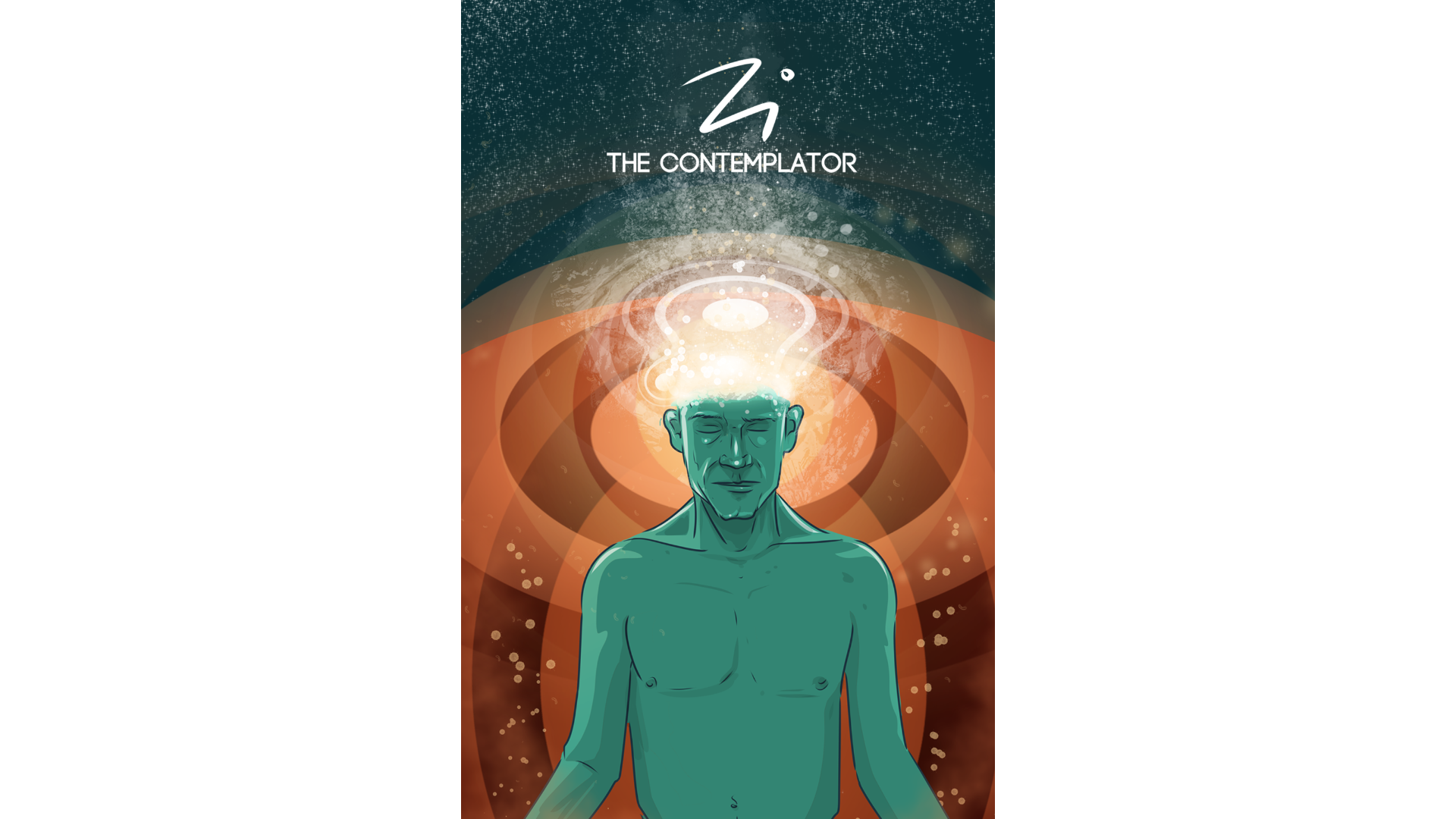
The Contemplator shows us how to access our subconscious mind. He encourages us to temporarily let go of thinking about our problems so that the subconscious mind can find a solution.
ARTWORK
After nearly a decade of working with this system, The Contemplator is probably the Servant I feel I know the least. Which, when you think about it, is exactly as it should be. He represents the part of our consciousness that we don’t have direct access to—the deep processing that goes on below the waterline—so of course he’s hard to understand with the rational mind. If I could describe him neatly and completely, he wouldn’t be doing his job.
The Contemplator artwork comes from the same early altar card series that a few of the other Servants originally came from, though I’m not sure I ever actually got around to printing this one or putting it out for sale. The original was very red in tone and was titled simply “Meditation”. I later used that original red version in the limited edition release of the deck for the fifth anniversary, so if you have one of those, you’ve seen The Contemplator as he first appeared, though the original art is much wider.
The image itself is a man with his eyes closed, and all the action happening where he can’t see it. The rings radiate out around his head like ripples on water, and the light gathers at the crown with those wisps rising off it, like something gently steaming away up there. The whole idea of the Servant is that something is absolutely happening, but not on the surface, and not anywhere the conscious mind can watch it happen. He isn’t doing anything, and that’s precisely the point. The work is being done for him, somewhere deeper down. It’s also worth noticing that he hasn’t actually got a brain. He is entirely open-minded.

THE SIGIL
The sigil was one of the ones I did in a sort of automatic writing way by just letting the pen move and seeing what came out. Some of the Servants’ sigils are clearly pictorial representations of something, such as The Road Opener’s sigil being a road, or The Monk’s sigil being the monk himself. This one isn’t like that. If I squint at it, it sometimes reminds me of a bird, or maybe the torso of a man lying down, but honestly, I don’t feel it’s a sigil that’s meant to look like anything. It’s The Contemplator, and he’s beyond the rational mind’s ability to grasp, so it seems right that his sigil should be too. If anything, it feels less like an image made for the subconscious and more like one that came from it.
The main way I use it is as a sort of handover device. Write your problem or question on a piece of paper, draw the sigil over it, then put the paper away in a drawer and deliberately forget about it. The putting-away is a big part of the working. You’re physically filing the problem away, and handing it over for The Contemplator to work on it.
It’s also a great one for sleeping on a decision. Draw the sigil on a slip of paper and put it under your pillow or on the bedside table, state the problem before you go to sleep, and see what messages come in dreams, or via insights over the next couple of days.
And if you’re stuck on a piece of creative work, draw the sigil, walk away, and go do something else entirely. Remember this isn’t about giving up, you are handing over the problem to a more expansive version of consciousness than we have access to in our normal waking state.
Sigil Quick Uses: Handing problems over to the subconscious, sleeping on a decision, recalling forgotten names and details, dream incubation, unsticking creative blocks, a focus for meditation.
DIVINATION
When The Contemplator appears in a reading, the message is pretty much always to stop consciously working the problem. Pull back from thinking about it altogether and let it percolate in the background.
The example I always give is trying to remember a famous actor’s name. You can sit there straining at it for ten minutes and get nowhere, but once you give up and put it out of your mind entirely, the name arrives about half an hour later while you’re doing the dishes. That’s The Contemplator, and that’s how he works. And in a reading, this card is telling you that whatever you’re currently wrestling with needs the same treatment. Whether it’s a decision, a creative problem, or a situation you can’t make sense of, it’s often when we relax and let go that the solution appears. Some problems are best solved by not thinking about them at all, or by sleeping on them overnight.
There’s a lot of Iain McGilchrist’s left brain–right brain work in this Servant, for those who know it. The Thinker is the narrow, analytical, grasping left hemisphere—McGilchrist’s Emissary—while The Contemplator is much closer to the Master: the broad, deep awareness that takes in the whole picture but can’t be ordered about or interrogated directly. Our modern culture massively overvalues the first and barely acknowledges the second, which might be why this Servant is so easy to overlook.
It’s worth being clear on how The Contemplator is different from the seemingly similar territory that other Servants inhabit, because there is definitely overlap which may cause confusion. The Monk is about decluttering, simplifying, retreat, and pulling back from the noise of the world to reconnect with yourself. The Contemplator isn’t suggesting that you withdraw from anything. He’s only asking you to take one specific problem out of your conscious mind’s hands and pass it down to a deeper level. And he’s not The Seer either. She’s intuition, the gut feeling in the moment. The Contemplator is slower and deeper than that. He’s the processing plant, working through everything you’ve ever stored.
The card can also suggest that something buried in your subconscious is colouring your judgement of the current situation. This could be an old idea, a limiting belief, a bad past experience, a shadow or role that’s quietly running in the background of your mind. If the reading feels less like “relax and wait” and more like “something’s off and I can’t tell what”, that’s the version to consider, particularly if The Devil also appears in the spread. What old rule might you be applying to a new situation?
Either way, the reassuring bit is that The Contemplator already has everything he needs to help sort this out for you. This Servant isn’t asking you to do more. It’s asking you to get out of the way.
SHADOW REVERSAL
Reversals in The Forty Servants don’t signify the opposite of the normal energy of the Servant, but more a dysfunctional version of it, or a detrimental misuse or misunderstanding of the qualities.
The most common shadow of The Contemplator is overthinking, or analysis to the point of paralysis, and endless rumination. This is what happens when the conscious mind refuses to make the handover. Instead of passing the problem down and letting it go, you keep hauling it back up to chew on it one more time, going round and round the same loop at three in the morning. Rumination feels like you’re doing real work, which is what makes it so seductive, but it’s the exact opposite of what this Servant does. Are you actually thinking about the problem, or just re-experiencing it on repeat? Have you had a single new thought about it in the last week, or are you just replaying the old ones over and over?
The other pole is a fear of introspection or avoiding any deeper self-reflection because you’re worried about what might surface. If The Contemplator knows more about you than you do yourself, then some part of you might prefer he kept it to himself. Are you keeping yourself busy so you never have to hear from the deeper parts of your own mind? Is there a question about yourself you’ve been very careful never to ask?

MAGICK
The core method, as with all the Servants, is the simplest one: put the card or the sigil in front of you and talk to The Contemplator out loud, like he’s a person in the room. But with this Servant, the details matter. Describe the problem as completely as you can with all the background, all the relevant bits and pieces, and everything you’d tell a friend who was hearing it for the first time. Think of it as if you’re briefing him. Then formally hand the problem over. The crucial part, and the genuinely difficult part, is to now try to put it out of your mind entirely. Within the next few hours, or maybe days, the solution will suddenly appear in your head fully formed, usually while you’re doing something completely unrelated or are otherwise distracted.
If you keep pulling the problem back up to see how he’s getting on, you’re taking it out of his hands each time. It’s a watched kettle. Hand it over and mean it.
The Contemplator is also the Servant for remembering things you have forgotten, for example, people’s names, phone numbers, or where you left your keys. Take a brief moment, mentally give him the request, and then let it go completely. Don’t force it and don’t pressure it. The answer arrives when it arrives, and it nearly always does.
He’s also excellent for habit work. The Contemplator is the keeper of everything that runs on automatic, so he’s the one to talk to when you’re transferring a new skill or routine into long-term memory, or trying to break an old pattern. Tell him what you want running in the background, and ask him to install it, or uninstall it.
And because he has access to all of your inner workings, your motivations, your long-forgotten memories, and everything you’ve done while you weren’t paying attention, you can simply ask him why. Why do I keep doing this? Why does this situation always play out the same way? The Contemplator can be a great aid when you are doing shadow work, personal development, or any sort of inner work.
SERVANT COMBINATIONS
As mentioned above, The Contemplator and The Thinker are, to my mind at least, the two halves of the mind itself—the right and left hemispheres, the Master and his Emissary. Use The Thinker first to define the problem clearly and gather the facts, then hand the whole thing over to The Contemplator for deep processing. I’d go as far as saying these two are the two factors that make up The Explorer, though he’s much more than the sum of his parts.
Combine The Contemplator and The Devil for inner or shadow work to help in uncovering the roots of whatever’s got hold of you. The Contemplator goes down into the subconscious and surfaces where the chain originally came from, and The Devil then can help you see how you are bound by it.
The Contemplator and The Seer combine well together to give you a complete inner guidance system. The Seer is your gut instinct while The Contemplator shows you the deep background processing. Between them, very little should get past you.
And that’s it for this time, I hope you got something good from it. If you’d like to chat about it, you can leave a comment below, or come find me on Bluesky, though I’m not terribly active over there.
If you would like to support this series and the rest of the stuff I do, then please consider a paid Patreon Membership, buying me a coffee, or sending a PayPal donation! All amounts, even very small ones, all really, really help to keep the engine running here.
So, until next time,
MAY YOUR BEST DAYS BE AHEAD!
Tommie